February 2026 Google Discover Core Update: How The Hyper‑Local Shift Changes Your Content Playbook Overnight
The February 2026 Google Discover Core Update quietly flipped the script on distribution, with US top‑1,000 Discover placements now controlled by only 158 publishers, an 8.1% drop that signals tighter competition and a clear bias toward hyper‑local relevance. If your content is not grounded in real neighborhoods, cities, and local identities in 2026, you are simply not in the game anymore.










Key Takeaways
| Question | Answer |
|---|---|
| What changed in the February 2026 Google Discover Core Update? | Discover now prioritizes hyper‑local content, timely updates, and subject‑matter expertise while dialing down sensational and clickbait‑style pieces. |
| Why is “hyper‑local” suddenly critical? | In tests, California‑local domains appeared about 5x more often in the California feed than in New York, showing a powerful bias toward local identity and location signals. |
| How can we adapt our content in 2026? | Focus on location pages, neighborhood guides, and local news content, supported by structured research tools like sitemap analysis to find gaps. |
| What types of local content work best now? | Location pages, service‑area pages, local reviews, and in‑depth coverage of events and regulations that impact a specific city or region. |
| How fast is the 2026 Discover Update rolling out? | Rollout began on February 5, 2026 in US English feeds and is expected to take about two weeks before expanding to more countries and languages. |
| Where should we start if we manage multiple locations? | Build a scalable local content system using tools like the Local SEO content generator approach to cover every city, town, and neighborhood you serve. |
1. What The February 2026 Google Discover Core Update Actually Did
Google’s own guidance in 2026 is clear: Discover is moving toward locally relevant, in‑depth, original content from real experts and away from shallow, sensational posts. The update started rolling out on February 5, 2026, with an initial English focus in the US and a planned multi‑language expansion in the following weeks. At the same time, independent DiscoverPulse data shows topic variety increasing while the number of publishers in the top results is shrinking. That combination tells us Discover is still surfacing a wide range of interests, but it is rewarding a smaller group that nails quality, authority, and local fit.
2. Why Hyper‑Local Content Became The New Gatekeeper In 2026
Post‑update data shows how aggressively local identity now drives Discover. In California, top‑100 local articles grew from 10 to 16, a 60% jump that lines up directly with the hyper‑local emphasis. Even more telling, New York‑local domains now appear roughly 5x more often in New York feeds than in California, and California‑local domains show the same 5x bias in their home state. Discover is not just “aware” of location in 2026, it is leaning on it as a primary filter.
3. The New Discover Quality Bar: Local, Timely, Expert, Non‑Sensational
Google’s 2026 guidance lists four recurring priorities for Discover: local relevance, timeliness, depth, and authenticity. That means your content strategy needs to serve real people on real streets, not generic personas. Practically, you win more attention in 2026 when articles answer questions like “what does this mean for people in Austin this week” instead of “what does this mean in theory.” Shallow listicles and thin re‑writes are getting less feed presence, while original reporting, local data, and expert commentary are moving up.
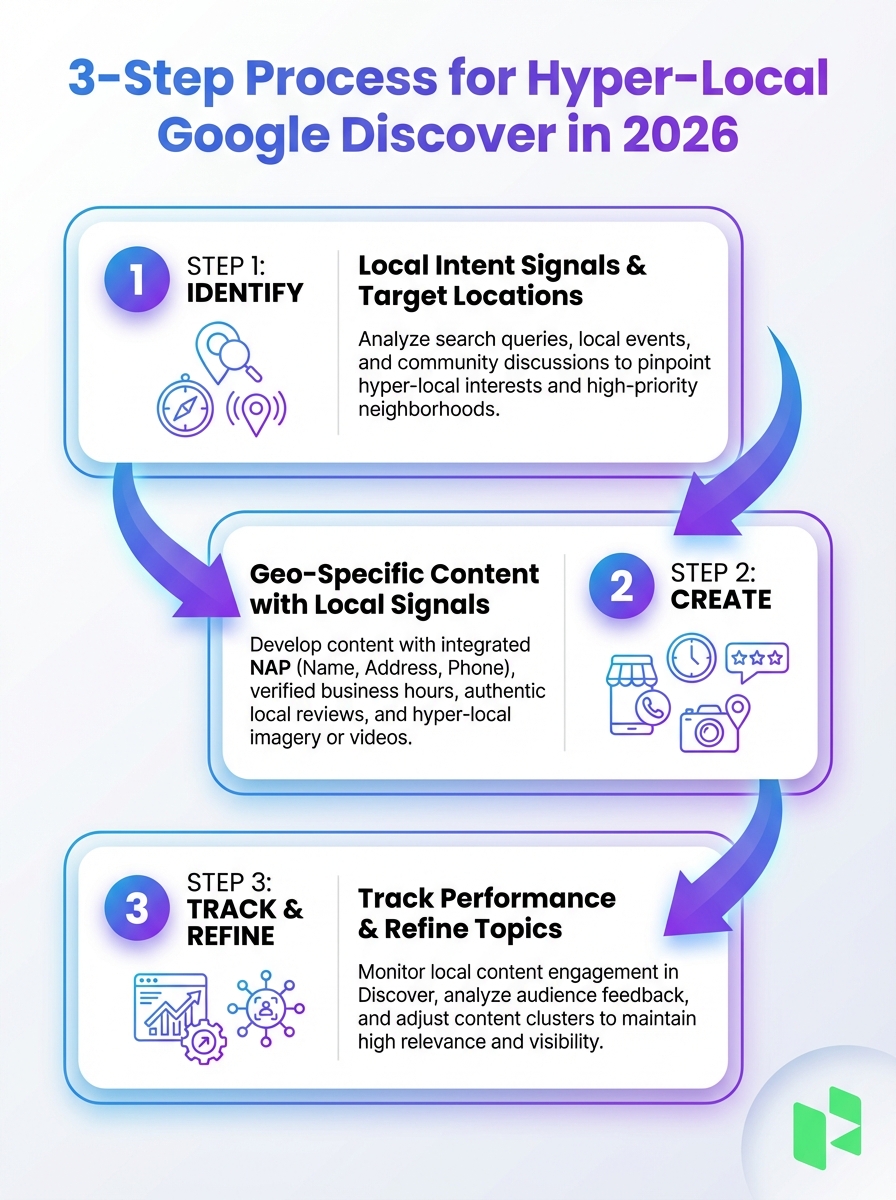
A quick visual summary of the February 2026 Google Discover Core Update and how hyper-local signals influence results in 2026.
Did You Know?
Across US, California, and New York feeds in 2026, the number of unique content categories in Discover increased while the number of unique publishers decreased, meaning broader topics but tighter distribution for those who get quality and local relevance right.
4. Content Types That Now Perform Best In Google Discover’s Hyper‑Local World
In 2026 we see a clear pattern: local content wins when it is specific, actionable, and recurring. At Harbor, we categorize high‑leverage hyper‑local formats into a simple playbook you can scale.- Location pages with detailed directions, hours, and neighborhood context.
- Service area pages that address each city or town individually.
- Neighborhood guides that read like what a local would tell a friend.
- Local reviews content that surfaces testimonials and star ratings.
- Local news and event explainers tied to regulations, openings, or disruptions.
5. Scaling Location‑First Content With A Local Content Generator Approach
If you operate in multiple cities in 2026, manual local content production does not scale. That is why we favor a template‑driven system similar to the Local SEO content generator approach, which is positioned around generating location pages, service area content, and local articles at volume. On that page, Harbor outlines a story value of roughly $20,000 for a full local content buildout, framed as the level of investment a serious multi‑location brand should expect to allocate. The point is not the exact figure, it is that local content is now core infrastructure, not a side project.| Content Type | What It Covers | Discover Benefit in 2026 |
|---|---|---|
| Location Pages | NAP, hours, services, local directions, testimonials | Strong local signals and expertise |
| Service Area Pages | Coverage of cities, towns, neighborhoods | Matches hyper‑local Discover feeds |
| Neighborhood Guides | What to know if you live or work in the area | High engagement, repeatable topics |
6. Using GEO Optimization To Align With Discover’s 2026 AI‑Driven Feeds
Discover in 2026 does not operate in a vacuum, it is influenced by the same generative and AI‑overview ecosystem that Google calls out publicly. Harbor’s GEO optimization framework is built for this environment, where “Generative Engine Optimization” connects with AI overviews and answer engines. We use tools like LLM perception analysis, entity fortification, and citation engineering to understand how AI systems interpret local brands and topics. If AI models do not see you as a relevant entity for “plumber in Denver” or “tenant rights in Brooklyn,” your Discover exposure will reflect that gap.
7. Discover Topic Planning: From Keyword Lists To Site‑Level Insight
The 2026 Discover environment punishes guesswork. Instead of brainstorming random topics, we lean on structured analysis like Harbor’s Site Seeker and sitemap research features to see exactly what competitors publish and where the gaps sit. Site Seeker, for example, identifies 75 high‑value keyword and topic opportunities from competitor sitemaps and organizes them into pillars and sub‑pillars. Paired with sitemap research, which reveals content architecture and update patterns, you can build a content roadmap that matches what Discover already rewards in your niche.
Did You Know?
In California during the February 2026 Discover update window, top-100 local articles increased from 10 to 16, a 60% surge that highlights how aggressively Google is promoting hyper-local stories in user feeds.
8. Refreshing Existing Articles To Match Discover’s 2026 Standards
Many sites have years of content that are “almost good enough” for Discover in 2026 but fail on timeliness, depth, or local specificity. Rather than starting from scratch, we use a structured refresh workflow similar to Harbor’s Reworker feature. Reworker is built to rewrite and expand existing articles, add new sections, update statistics, and improve readability. For Discover, that means taking a generic “moving tips” article and turning it into “moving tips for families relocating to Austin in 2026,” with references to schools, commute times, and local regulations.9. Internal Linking And Topical Clusters That Signal Local Authority
Discover’s hyper‑local bias does not operate only at the single‑article level, it also looks at whether your whole site behaves like a true authority on a topic in a place. That is where smart internal architecture comes in. We mirror the ideas behind Harbor’s Internal Linking feature, which emphasizes pillar‑cluster structures, contextual relevance, and orphan page recovery. For a city like Chicago, that might mean one core “Chicago business hub” pillar with clusters on neighborhoods, industries, and recurring local topics, all interlinked.- Pillar pages that define the main Chicago topic or industry.
- Cluster pages that cover specific neighborhoods, services, or regulations.
- Contextual internal links that connect related local angles across the site.
10. Agentic AI And Always‑On Adaptation To Discover Shifts
The February 2026 update will not be the last local‑heavy adjustment we see. Waiting for quarterly reports is already too slow, which is why we are bullish on agentic workflows like those described on Harbor’s Agentic AI page. Agentic systems decompose objectives, pick the right tools, and loop through research, writing, and internal linking automatically. For Discover, that means continuously spotting new local trends, generating matching content, and wiring it into your topical clusters while the story is still hot in the feed.11. Putting It All Together: A 2026‑Ready Hyper‑Local Discover Strategy
To operate effectively after the February 2026 Google Discover Core Update, you need a tight, process‑driven system, not scattered experiments. We recommend a simple, repeatable framework.- Map your markets by city, neighborhood, and audience segment.
- Audit competitors with sitemap and topic research to see what Discover already favors.
- Build scalable templates for location pages, guides, and news explainers.
- Refresh legacy content to make it locally specific, current, and expert‑driven.
- Wire everything together with pillar‑cluster internal linking and continuous agentic monitoring.